
Settling In & Routines
Bringing a rescue dog into your home comes with a mix of excitement, questions, and a few unknowns. This page brings together practical, real-world guidance to help you navigate those early weeks with confidence. From understanding body language and routines, to introductions, crate training, and everyday safety, it’s all about helping your dog feel secure and supported as they settle into family life.
Introducing Rescue Dogs Safely
Introducing a rescue dog to new people, children, or other dogs should always be done slowly, calmly, and with realistic expectations. Many rescue dogs are adjusting to completely new environments, routines, sounds, and experiences. Even friendly dogs can feel overwhelmed during introductions if too much happens too quickly. Taking things at the dog’s pace helps build confidence, trust, and positive associations from the beginning.
Not all dogs are ready for immediate interaction, especially when adjusting to a new environment. Introductions should always be calm, controlled, and led at the dog’s pace.
- Start with neutral, calm environments wherever possible
- Avoid face-to-face or forced greetings
- Allow dogs to observe each other from a comfortable distance
- Use barriers such as pet gates or leads for safe, gradual introductions
- Keep leads loose and handler energy calm
- Pause or separate if either dog shows signs of stress or overwhelm
- Give regular breaks to prevent pressure building
Positive relationships between dogs often develop gradually over time, rather than immediately.
Children and dogs should always be supervised together, particularly during the early settling-in period. Excitement, noise, and fast movement can easily overwhelm nervous or newly arrived dogs.
- Encourage calm, gentle behaviour around the dog
- Teach children to respect space during rest, sleep, or feeding
- Avoid hugging, climbing on, or crowding the dog
- Allow the dog to choose when and if they approach
- Provide quiet areas where the dog can retreat undisturbed
Safe, positive relationships are built slowly through calm, consistent interactions over time.
Every rescue dog is different. Some settle quickly and enjoy social interaction immediately, while others need much more time to feel comfortable and secure. Allowing dogs to move at their own pace creates safer introductions, stronger relationships, and more successful long-term adjustment to home life.
Crate Training for Rescue Dogs
A Safe Space, Not a Punishment
Crates can mean very different things to different rescue dogs. Some may never have seen one before, others may feel unsure or frightened by them, and some may already associate them with comfort and security. For many Romanian rescue dogs, crates can also be linked to long transport journeys on the way to safety, meaning responses can vary widely, from avoidance to immediate comfort. Every dog’s experience is individual, and there is no “right” reaction.
When introduced gently and positively, a crate can become a valuable safe space within the home. It can offer:
- A quiet place to rest
- A retreat from busy environments
- A predictable space for decompression
- A secure area where a dog can relax without pressure
For many rescue dogs adjusting to a completely new environment, having a small, consistent space of their own can help reduce stress and support emotional stability.
- Crate training should never be forced
- The crate should always feel safe and positive
- Some dogs need more time to build confidence
- Doors do not need to be closed initially
- Dogs should always be allowed to explore at their own pace
The goal is for the crate to become a place associated with comfort, rest, and safety — never fear or punishment.
Every dog will react in their own way:
Some dogs may:
- Settle immediately in a crate
- Sleep better in enclosed spaces
- Use the crate as a retreat when overwhelmed
Others may:
- Avoid the crate completely
- Become anxious when the door closes
- Need slow, gradual confidence building
Both responses are completely normal.
Helpful ways to introduce a crate include:
- Leaving the door open initially
- Scattering treats inside
- Feeding meals nearby or inside the crate
- Adding soft bedding and enrichment toys
- Allowing free movement in and out
- Keeping all interactions calm and pressure-free
Small, positive experiences build trust over time.
- Punishment
- Long periods of isolation
- Forcing fearful dogs inside
- “Dominance” or control-based training
Crate training is not about confinement. It is about giving a rescue dog something many have never truly had before. A safe place where they can fully relax.
What’s the Difference Between Y and H Harnesses?
Choosing the right harness plays an important role in your dog’s comfort, movement, and long-term wellbeing. While both Y-harnesses and H-harnesses are commonly used, they are built very differently and have different impacts on how a dog moves.
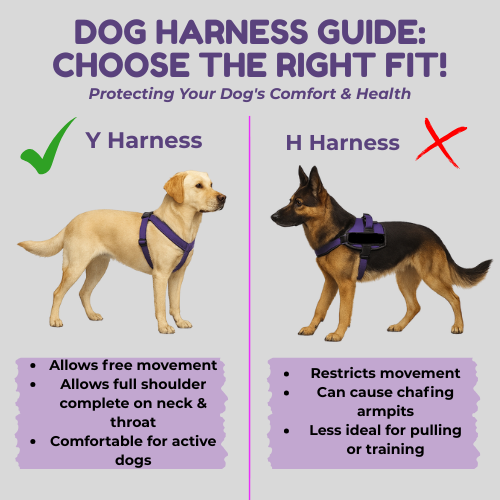
Y-Harness
A Y-harness is designed so the chest straps form a “Y” shape, sitting lower on the body and avoiding restriction across the shoulders. This allows the dog to move more freely and naturally, supporting a comfortable walking posture.
Key benefits:
- Allows natural shoulder movement without restriction
- Supports a smooth, fluid walking gait
- Reduces pressure on the neck and throat
- Suitable for dogs with breathing sensitivities or delicate builds
- Comfortable for everyday walks and longer outings
- Often includes a front-clip option to support loose-lead walking
For most dogs, a properly fitted Y-harness provides the best balance of comfort, safety, and freedom of movement.
H-Harness
An H-harness forms an “H” shape, with straps across the chest and around the ribcage. It is designed to provide a more structured fit, which can offer additional control in some situations.
Key characteristics:
- Provides a secure, structured fit around the body
- Often used for stronger dogs or heavy pullers
- Can offer additional handling control during walks
- Suitable for short-term or specific training needs
- May restrict natural shoulder movement
- Can affect stride and long-term joint comfort in some dogs
- Chest and girth straps may cause rubbing and hair loss under the legs
While still safer than a collar, the H-harness prioritises control over full freedom of movement.
Food & Upset Tummies
It’s very common for dogs arriving into our care from both Romania and the UK to experience mild upset tummies. This is usually caused by stress, travel, and the change in environment, routine, and diet as they settle into foster or adoptive homes.
In most cases, this is temporary and improves as the dog begins to feel safe and comfortable. If a dog does experience an upset stomach, we advise temporarily switching to a simple, bland diet until things settle. We often suggest plain turkey with sweet potato as an alternative to the more traditional chicken and rice, as this can be easier for some dogs to digest.
To support digestive health, some adopters / fosters also find pumpkin powder helpful for settling sensitive tummies, and YuMOVE supplements may be used as an additional option for gut and overall wellbeing. Some dogs may also have sensitivities or allergies to certain proteins, grains, or ingredients. If this is suspected, we recommend using resources such as the All About Dog Food website to help explore suitable dietary options.
Some dogs may also benefit from a raw feeding approach, particularly where this is already part of their routine or where they have struggled with more processed diets in the past. A raw diet can, for some dogs, support improved digestion and firmer stools, as well as healthier skin and coat condition due to its natural nutrient profile and reduced exposure to fillers or artificial additives.
That said, raw feeding is not essential for every dog, and suitability can vary depending on the individual dog’s health, history, and needs. If a raw diet is being considered, we recommend introducing it gradually and ensuring it is nutritionally balanced and appropriate for the dog in question.
Decompression & Why It Matters
When a dog first arrives into foster or adoptive care, everything in their world changes at once. They are suddenly surrounded by new people, smells, sounds, routines, foods, and environments, often after a long and stressful journey. From the dog’s perspective, they have no understanding of what has happened or what our intentions are. Because of this, the first days in a new home are incredibly important. This period, known as decompression, is when the dog begins to mentally and physically adjust and start to feel safe.
During this time, dogs may appear shut down, overly excited, nervous, or unsure. Some may seem confident at first and then become more anxious after a few days. Without proper space to decompress, dogs can experience Trigger Stacking, where multiple stressful experiences build up without enough recovery time. This can leave them feeling overwhelmed or reactive in situations they would not normally struggle with.
On average, it can take around 7 days for a dog to begin decompressing from a major change, although this varies depending on the individual dog and their background. For some, especially those who have travelled long distances or experienced significant stress, it may take longer. This is why the first week is so important. A calm, predictable environment with minimal pressure helps the dog settle, build trust, and understand they are safe, laying the foundation for confidence, behaviour, and a strong bond with their foster or adoptive family.
Lead Training
Many of the dogs entering our care will have never worn a collar, harness, or lead before. For some, this can feel very unfamiliar and even frightening at first. It is common for dogs to initially buck, pull, freeze, or try to escape as they try to understand what is happening. Because of this, we always recommend a patient, positive reinforcement-based approach to lead training. Taking things slowly and rewarding calm behaviour helps the dog build confidence and begin to associate the lead and harness with safety and positive experiences.
We suggest starting in a calm, secure environment such as the home or garden before progressing to quieter outdoor spaces. Short, positive sessions are key, allowing the dog to gradually build trust and understanding without feeling overwhelmed. With time, consistency, and reassurance, most dogs learn that the lead is nothing to fear and begin to enjoy walks as their confidence grows.
When introducing a harness, allow the dog to see and sniff it first, rewarding any calm or curious interaction. You can then gradually build up to placing it over the head by using treats as encouragement, such as guiding the dog to place their head through a treat held on the other side. This process should always be done slowly, breaking it down into small, positive steps until the dog is comfortable wearing the harness. Sometimes, it is also helpful to allow a lightweight lead to be dragged around the home under supervision, helping the dog adjust to the feeling of a lead, without any pressure or restrictions.
Pack Theory Has Been Debunked
For many years, dog behaviour was explained using “pack theory” the idea that dogs try to dominate humans and establish themselves as the “alpha.” Modern science has shown this is not true.
The original research was incorrect
Pack theory came from studies on wolves kept in captivity. These wolves were unrelated adults forced to live together, which caused unnatural conflict. The researcher who first proposed the idea later rejected it.
Dogs are not wolves
Domestic dogs have lived alongside humans for thousands of years and do not behave like wolves. They do not form packs with strict hierarchies, and they are not trying to take charge of the home.
Behaviour is not about dominance
Dogs show unwanted behaviours because of fear, stress, confusion, lack of training, or because the behaviour has been reinforced. It is not an attempt to be in control.
Dominance based training can be harmful
Methods that involve force, intimidation, or “showing the dog who’s boss” can increase fear and aggression and damage the dog’s trust.
What works instead
Research supports using reward-based training, clear boundaries, consistency, and meeting a dog’s emotional and physical needs. This approach builds confidence, trust, and long-lasting behaviour change.
For further reading, see:
https://positively.com/dog-training/article/ethology-why-pack-theory-is-wrong